
The 43.43 metre tall rocket lifted off at 5.28 pm from the second launch pad at the Satish Dhawan Space Centre in Sriharikota

India's heavy-lift rocket GSLV MkIII, carrying communication satellite GSAT-19.

Indian Space Research Organisation plans to undertake next month the first developmental flight of a "game-changer" rocket capable of launching four-ton class of satellites from Sriharikota spaceport, says its Chairman A S Kiran Kumar.

GSLV-MK III, which uses a homegrown cryogenic engine, has to do at least two more launches before it begins commercial operations, report Raghu Krishnan and T E Narasimhan.
And the first Indian to go into space from 'Indian soil' could well be a woman.

India's premier Space Research Organisation is targetting up to 10 launches a year by 2016 , a top ISRO official said on Monday.
Global analysts say a successful launch of operational GSLV MkII rocket will reduce dependency for ISRO on foreign launchers.

With the launch of GSLV-MK III, slated for April, it will be able to cater to bigger satellites as well.

ISRO is focusing on more launches including that of a communication satellite from French Guiana next month.

Flight Lieutenant Srikant Sharma said that getting into the armed forces was a dream come true and this opportunity is an "icing on the cake".

A truly 'made in India' satellite that will empower a digital India.

Except Pakistan, seven SAARC countries are a part of the project.

Around four lakh people who attended the event were treated to a spectacular flying display of fighter, civilian aircraft and helicopters.
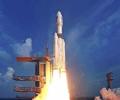
If successful, this would increase capacity to hurl small satellites into space, meeting both local demand and serving global customers.
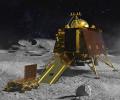
Asked if the lander was 'damaged' during the 'hard landing", Sivan said: "That we do not know".

The Bengaluru skies dazzled with somersaults and stunts by metal birds.

The space agency lines up GSLV-III and Chandrayan-II in 2017-18.

The heaviest rocket of the Indian Space Research Organisation -- LVM3-M2/OneWeb India-1 -- blasted off from the Sriharikota spaceport on Sunday to place 36 broadband communication satellites into the Low Earth Orbit (LEO) for a UK-based customer.

GSAT-18, which aims at providing telecommunications services for the country by strengthening ISRO's current fleet of 14 operational telecom satellites, was launched into a Geosynchronous Transfer Orbit about 32 minutes after the lift-off.

Other than the Cartosat-2 series satellite, the PSLV is carrying 29 nano satellites from 14 countries - Austria, Belgium, Chile, Czech Republic, Finland, France, Germany, Italy, Japan, Latvia, Lithuania, Slovakia, the United Kingdom and the United States of America besides a nano satellite from India.

The Rs 978 crore mission, which has been rescheduled for Monday after scientists corrected the glitch in the rocket, will be launched at 2.43 p.m from the second launchpad at Satish Dhawan Space Centre, over 100 km from Chennai.

ISRO chairman A S Kiran Kumar talks of what's on and what lies ahead for the Indian space agency.
